May 27, 2026 | 4 min read
Last week, while most of the marketing industry was debating whether ChatGPT ads were a threat to Google, Google quietly did what everyone was arguing about.
It embedded a sponsored listing inside an AI-generated answer. Not above it. Not below it. Inside it. Formatted identically to the organic recommendations around it, separated from the editorial content by nothing more than a small “Sponsored” label.
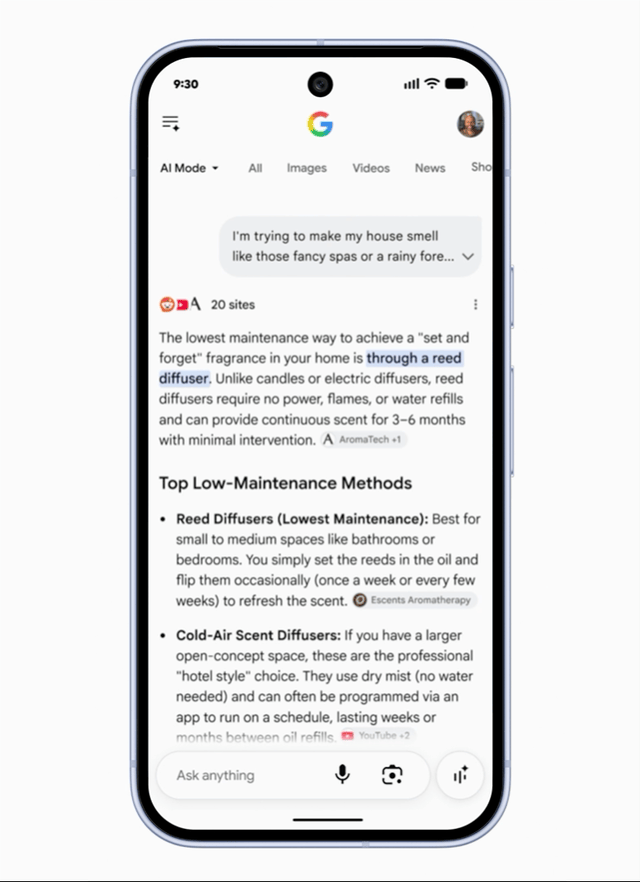
That screenshot went viral on LinkedIn on May 25. A user typed “I want to buy a new coffee maker” into Google AI Mode, and the AI responded with a list of recommendations. In the middle of that list, a paid KitchenAid listing appeared. Same visual weight. Same card layout. Same font. Just one small word to tell you it was bought and paid for.
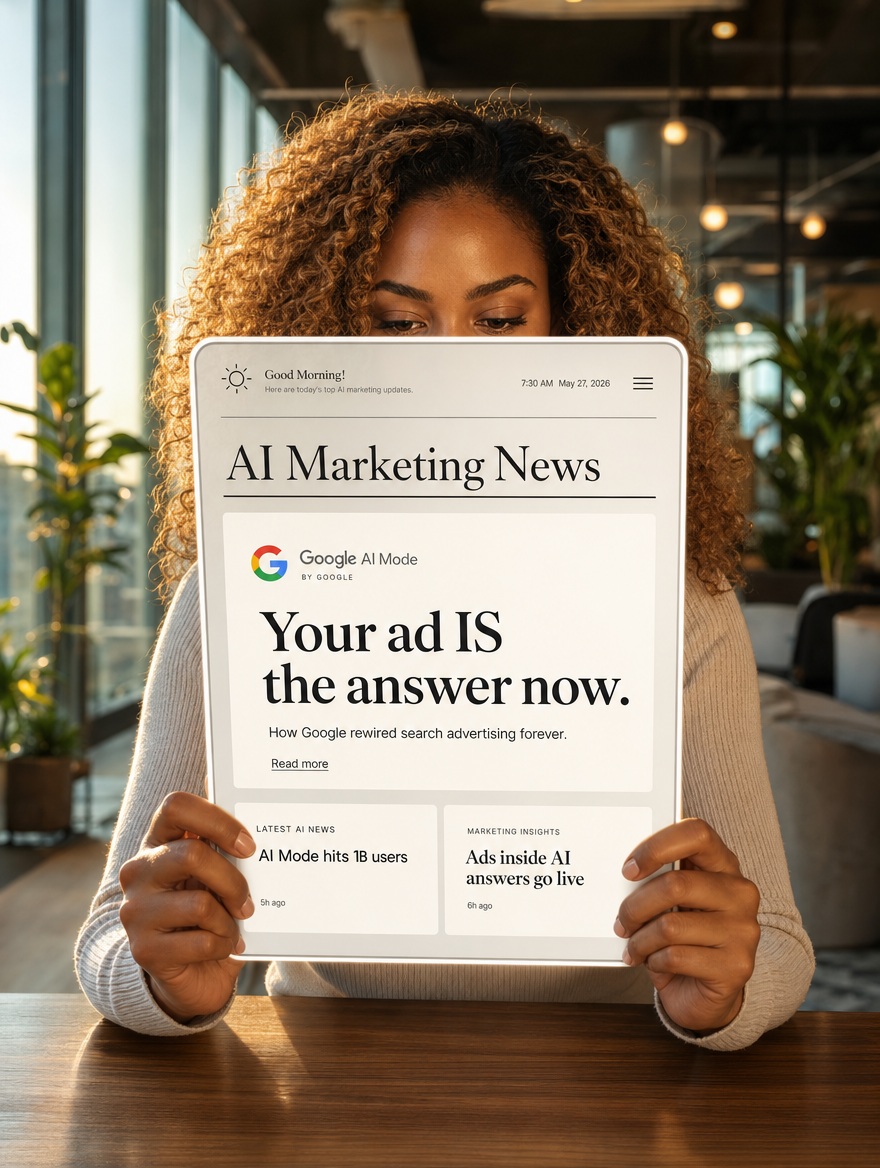
This is not a test or a rumor. Google formally announced the new format at Google Marketing Live on May 21, 2026. And the surface it runs on has now crossed 1 billion monthly active users globally.
What Actually Happened
Google AI Mode, which launched in the US in May 2025, has grown faster than any search feature in the company’s history. Query volumes have more than doubled every quarter since launch. Google confirmed the 1 billion monthly active user milestone on May 19, 2026.
At Google Marketing Live four days later, Google’s VP of Ads and Commerce, Vidhya Srinivasan, described the new ad philosophy in a single line:
“Now, you can ask Google anything, so the best ads must be answers.”
The company unveiled four new ad formats built specifically for AI Mode: Conversational Discovery Ads, which return creative tailored to the specific query and paired with a Gemini-written explainer; Highlighted Answers, which surface high-quality ads as recommendations inside list-style responses; AI-powered Shopping Ads, which use Gemini to write custom product explainers for category queries; and Business Agent for Leads, which replaces static lead forms with a Gemini-powered chat agent embedded directly inside the ad unit.
Ads now appear in 25.5% of AI-generated results, up 394% year over year. AI Mode queries are on average three times as long as traditional searches. One in six queries is non-text, using voice or images.
Why This Hits Different for Marketers
For about twenty years, search advertising worked on a simple architectural principle. There was a clearly marked paid zone at the top of the results page, and there was an organic zone below it. Position itself communicated “this is an ad.” Users developed a mental model around that layout, and advertisers built entire strategies around occupying that top real estate.
That model no longer applies at scale.
When your ad appears mid-conversation inside an AI-generated answer, it is not positioned above or below anything. It is woven into the fabric of the response. A user asking for coffee maker recommendations gets a response that flows from editorial context to sponsored product to editorial context again, with a Sponsored label as the only interruption. The visual continuity lends commercial credibility to every entry in the list, paid or not.
This is a meaningful structural change, not a cosmetic one. Before, ranking determined visibility. A number-one organic result reliably appeared at the top of the page. Inside an AI-generated answer, ranking no longer guarantees you appear in the response at all. The AI selects what to surface based on its model of relevance, and then the ad auction runs on top of that.
Attribution is also breaking in ways that most analytics dashboards have not caught up with. Google has announced agentic checkout capabilities that allow AI agents to complete purchases on behalf of users. Those conversions can occur with no session, no UTM, and no trackable click path. The conversion exists in Google’s data before it appears in yours.
What to Do This Week
First, audit your product feed quality now, not next quarter. AI Max for Shopping, which Google announced on April 30, 2026, matches ads to conversational queries using product attributes rather than keywords. If your feed contains only a product name and a price, the AI has almost nothing to work with when a shopper asks a detailed, multi-clause question. Add material, fit, use case, and relevant descriptors. This is the most actionable lever you control right now.
Second, set up a test campaign using Google’s new Conversational Discovery Ads format. These units are designed specifically for AI Mode placement and are served to users mid-answer. You will get early performance data on what creative approach works in a conversational context before the format becomes fully competitive. Brands that move first in a new placement consistently capture the lowest CPMs in that placement’s history.
Third, build a measurement strategy that does not depend entirely on last-click attribution. Specifically, set up a regular Google Ads data export to compare in-platform conversion volume against what your CRM or backend records. The gap between those two numbers will widen as agentic behaviour increases. That gap is your new baseline. Track it weekly.
The broader shift is this: Google is no longer selling you ad inventory in a search results page. It is selling you a position inside a conversation. That distinction sounds abstract until you realise your creative, your targeting logic, and your measurement model were all built for the old context, not the new one.
What is your current plan for adapting your campaigns to AI Mode? I am genuinely curious how different teams are approaching this.
Found this useful? Drop a comment below — I read every one.
I built a free tool that audits your website in 60 seconds. You get a score, an AI voice summary, and a step-by-step PDF. → edwinrogers.com/audit
Follow for daily AI marketing breakdowns, every morning → @edwinrogerscom
#AI #Marketing #DigitalMarketing #AIMarketing #GoogleAds #GoogleAIMode #SearchMarketing #AIAdvertising #PPC #GoogleMarketing #GeminiAI #MarTech #SearchAds #AISearch #ConversationalAI #PerformanceMarketing #SEO #AIAgents #LinkedInMarketing #ThoughtLeadership #BuildInPublic #DigitalArchitect