ChatGPT Just Opened Its Ad Platform to Everyone. Here Is What Marketers Need to Do Right Now.
By Edwin Rogers · · 4 min read
May 26, 2026 | 5 min read
On May 5, 2026, OpenAI did something that should have every performance marketer paying close attention.
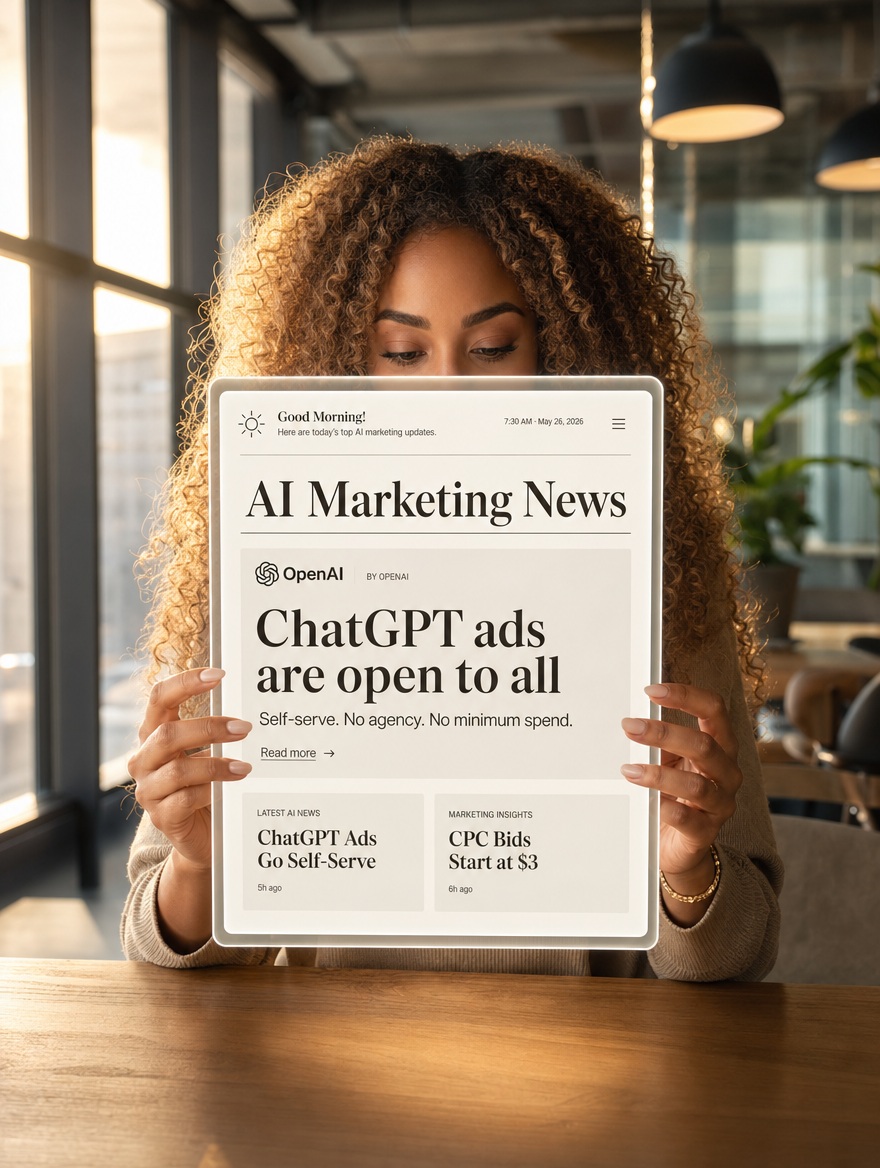
They opened ChatGPT’s advertising platform to self-serve buyers. U.S. businesses can now create, manage, and optimize ad campaigns directly inside ChatGPT. No agency relationship required. No minimum spend. CPC bids start at $3.
This is not a rumor. This is not a pilot restricted to Fortune 500 brands. This is an open beta, and the infrastructure behind it is more serious than most people realize.
What Actually Happened
OpenAI launched a beta Ads Manager platform on May 5, 2026, alongside CPC bidding and expanded conversion tracking tools.
Until now, advertising inside ChatGPT required working through managed agency relationships or large platform partners. Dentsu, Omnicom, Publicis, and WPP were the gatekeepers. If you were not running seven-figure media budgets, you were not in the room.
That changed on May 5.
Now any U.S. advertiser can register directly, upload creative, set a bid, and start measuring. Cost-per-click campaigns run at a recommended starting bid of $3 to $5 per click. CPM campaigns default to a $60 maximum bid. OpenAI confirmed both buying models will remain available as the platform scales.
“We’re creating a new ads model, one that supports businesses and broader access to AI while staying grounded in clear principles around answer independence, privacy, and user control.”, David Dugan, Head of Global Solutions, OpenAI
The ad tech infrastructure is already in place. Adobe, Criteo, Kargo, Pacvue, and StackAdapt are all integrated. Conversion tracking runs through a Conversions API and pixel, matching the standard measurement stack you already use on Google and Meta.
Why This Hits Different for Marketers
Think about the last time you used ChatGPT. You were not scrolling mindlessly. You were looking for something. You asked a specific question and you were waiting for a specific answer.
That is the environment your ad enters when it runs inside ChatGPT.
Compare that to a social feed, where the average user sees your banner for under two seconds between videos of their cousin’s dog. ChatGPT users are in active research mode. They are comparing products, evaluating services, and asking for recommendations before they buy. The intent behind the interaction is fundamentally different.
The early numbers back this up. AI-referred conversion rates in retail are approaching twice those of traditional search, based on data from advertisers running campaigns through Criteo. More than 1,000 brands are already live.
For performance marketers, the CPC model is a meaningful advantage. You are not paying for impressions on passive eyeballs. You are paying when someone actively clicks through from a recommendation inside an AI conversation. The audience has already done half the work of qualifying themselves before they reach your landing page.
The other shift worth naming: the agency layer is gone. You do not need a holding company relationship to test this channel. A small in-house team with a modest budget can be live this week.
What to Do This Week
First, register for access at the OpenAI Ads Manager beta. The rollout is currently limited to U.S. advertisers and expanding gradually. Getting your account registered now puts you ahead of the queue before broader access opens up.
Second, start with a CPC test at the low end. The recommended starting bid is $3 to $5 per click. Run it against a product or service page where you already have conversion data from Google or Meta. This gives you a clean comparison without building entirely new measurement infrastructure from scratch.
Third, audit your creative for conversational context. Banner ads designed for social feeds do not translate well to an AI environment. Users inside ChatGPT are reading and thinking, not scrolling. Your ad should feel like a relevant recommendation, not an interruption. Rewrite your headlines for intent. Lead with the outcome the user is already looking for.
The Bigger Picture
Google built a $200 billion ad business on the idea that people with intent are the most valuable audience in advertising. OpenAI is building the same thesis, inside a platform that is growing faster than any consumer product in history.
OpenAI is targeting $2.5 billion in ad revenue in 2026. Their stated long-term target is $100 billion annually by 2030.
I am not saying this replaces Google tomorrow. But the marketers who test it early, build the measurement baseline, and learn the creative formats will be the ones with the real advantage when this channel scales.
The first brands to figure out Facebook Ads had roughly two years before everyone caught up. The same window is open right now inside ChatGPT. It will not stay open forever.
Are you planning to test ChatGPT ads in 2026, or are you waiting to see how it develops? Drop your thinking in the comments below.
Found this useful? Drop a comment below, I read every one.
I built a free tool that audits your website in 60 seconds. You get a score, an AI voice summary, and a step-by-step PDF. → edwinrogers.com/audit
Follow for daily AI marketing breakdowns, every morning → edwinrogers.com
#AI #Marketing #DigitalMarketing #AIMarketing #ChatGPT #OpenAI #AIAdvertising #SearchMarketing #PPCMarketing #AdTech #LinkedInMarketing #ThoughtLeadership #PerformanceMarketing #MarTech #PaidMedia #AISearch #DigitalAdvertising #MarketingStrategy #FutureOfMarketing #ContentMarketing